
The French Revolution: The Uprising That Changed the World
Imagine the winter of 1788 in Paris. The smell of something as simple as bread that no one could afford fills the city. Women hold coins now widely considered worthless in long queues that wind around bakery corners. Their children are hungry. Their husbands, unemployable. And only a short drive away, behind the gilded gates of the Palace of Versailles, a king and queen sit hosting banquets with more food than these families will have in a month. Something is about to snap.
To understand how France blew up, one needs to see how it was stacked — almost angrily unfairly — on the backs of the people at the bottom. The Ancien Régime was a type of French society during the reign of the monarchy which existed as an institutionalised system of stratification divided into three Estates. The clergy represented the First Estate; the Second, the nobility. The rest of the country, all ~97% of it — merchants, lawyers, peasants, labourers; anyone else who lived by their wages — was considered part of the Third Estate. And the cruel punchline: the only Estates with actual power were the First and Second, who also did not pay taxes. All the weight of financing the French state rested on those shoulders least able to bear it.
In 1774, King Louis XVI inherited this Powder Keg. He was generally not considered a bad man — more clumsy than cruel, less villainous than indecisive. Yet in a country in extremis, paralysis can be tragic too. His wife, Marie Antoinette of Austria, became a lightning rod for public anger. True, she never uttered the phrase “Let them eat cake,” but it mattered little – the people believed she was above their suffering and in politics, perception is everything.
France was also nearly bankrupt. The treasury had been hollowed out by two decades of expensive wars, even paying for part of the American Revolution. Efforts to tax the nobility were unsuccessful. Poor yields of 1788 ballooned grain prices. Regular folks were forking over 90% of their paycheck for just bread. The country wasn’t just angry. It was desperate.
This desperation is where the ideas walked in. Enlightenment thinkers had been quietly lighting fuses for decades. His harsh, dangerous humour had been a satirical attack on the Church and upper classes. It had long been realised that Montesquieu had been right, and that the ideas of separation of powers and constitutional government — sans any suggestion that kings can reign undeterred. None more electrifying than Jean-Jacques Rousseau, who argued that political power was neither divine nor hereditary but lay with the people themselves — what he termed popular sovereignty. These concepts were no longer simply ideas on paper: liberty and equality — as well as ignorance of natural rights. They were weapons. The third estate has been reading.
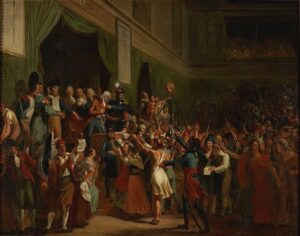
Louis XVI called the Estates-General—the assembly of France’s three estates—for the first time since 1614, in May 1789 at the height of a financial crisis. A gated debate on taxes, or at least that was the plan. It was like a match dropped in a barn of hay. The Third Estate had grievances and aspirations that their rulers had woefully underestimated. Louis tried to keep the delegates out of the proceedings, but they wouldn’t go. By the end of this month, they were banned from their meeting place and met in an indoor tennis court nearby and took an oath that stopped history in its tracks: No inducements would persuade them to go until France had a written constitution. The Tennis Court Oath was a formal statement of opposition. They said men would not bow to the visage of kings.
Then, July 14.
There were reports that Louis was assembling troops around Paris to suppress the rebellion. The Parisians didn’t wait to see. On the morning of July 14, 1789, a crowd stormed the Bastille, a medieval fortress and royal prison that had come to symbolise everything wrong with the old order. There was fighting for several hours until the garrison surrendered. They put the governor’s head on a pike and marched it around the streets. Yes. It was evil. But it was also a statement: the French people had taken back their power by force.
From then on, the revolution spread quickly. The new National Assembly passed in August 1789 the Declaration of the Rights of Man and of the Citizen — a document that reverberated around the globe like a bell. It proclaimed that all men are born free and equal in rights. Liberty, property, security, resistance to oppression — these rights were not privileges to be bestowed by kings. They were natural rights. Thirteen years earlier, the American Declaration of Independence had expressed this platitude, but that was America; the centre of gravity of Europe is much nearer to France, so it ricocheted everywhere.
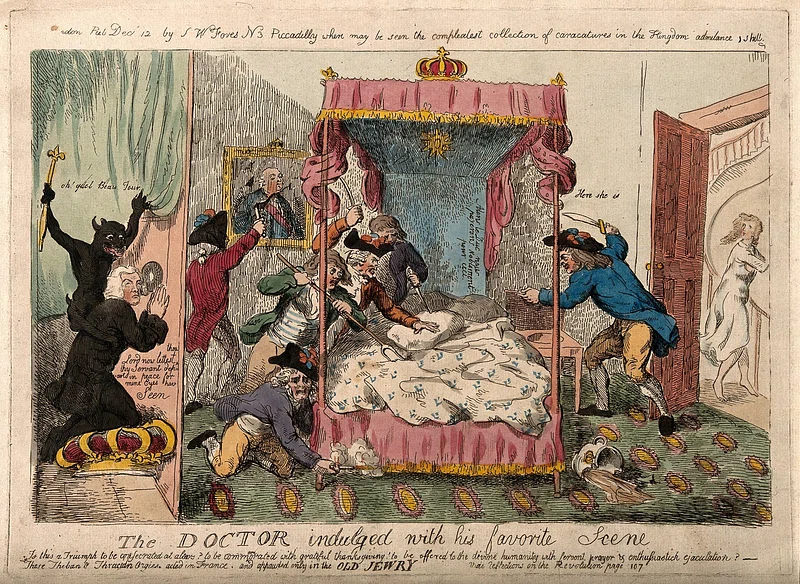
But revolutions‚ once unleashed‚ don’t stay polite for long․. The early optimism curdled․. These factions fought with each other․. In 1791‚ Louis XVI was caught trying to leave France․. This defeat ended the monarchy’s remaining popular support․. He was guillotined in January 1793‚ on the Place de la Révolution‚ before an indifferent audience‚ followed by Marie Antoinette in October․.
However, revolutions quickly lose their civility. Optimism gave way to disappointment, and fledgling revolutions splintered into rival factions. Louis XVI was captured in 1791 attempting to escape from France, an act of treason that extinguished the last remnants of the people’s belief in the monarchy. By January 1793, Louis was guillotined in the Place de la Révolution, leaving the crowd silent. His wife, Marie Antoinette, was executed in October.
The aftermath of the revolution resulted in even more unwanted systems than the revolution sought to remove. As the public’s desired change took shape, the Reign of Terror began. Robespierre caused the Reign of Terror personally. He presided over the Committee of Public Safety and eventually became the most powerful and influential member of the organisation. Like all the other revolution leaders, Robespierre was fueled by the guillotine’s low hum. The machines were used repeatedly from 1793 to 1794, hitting all those truly, allegedly, or even potentially a threat to the revolution. Reports show that 17,000 to 40,000 people were killed. The revolution was ignited in the name of liberty and ended in the name of fear. Robespierre was arrested on the 27th of July, 1794, and was executed the next day by the same means.
A young Corsican general of revolutionary experience and pronounced ambition, Napoleon, walked out of the destruction caused by the revolution. Napoleon, who gained attention during the Revolutionary Wars and came to dominate France by 1799 with a coup, was not the leaders’ hopes for the revolution. However, when he conquered Europe, he brought along the revolutionary ideas of legal and social equality along with codified rights and a structured legal and social system. These ideas he spread voluntarily.
The reason any of this still matters: every time a different country writes a constitution, every time a government is put to the test by its people, every time someone says rights belong to humans and not to kings — you hear 1789 whispering in the background. The French Revolution was a bloody, foul mess. It devoured most of the people who created it. Yet it unleashed a reality where the divine right of kings wouldn’t cut it any more, where letting ordinary people have a voice in how they’re ruled ceased to be radical, and started being self-evident. That rift has never completely healed since it broke open. And the world — slowly, painfully, imperfectly — has not been the same since.